Uriage Xemose Eye Cream Review 2026: Real Relief?
Dry, flaking eyelids are their own kind of misery. Regular eye creams sting, and thick body balms feel far too heavy so close to the lash line.
That gap is exactly where Uriage Xémose Soothing Eye Contour Care sits. It is a French pharmacy cream built for very dry, atopy-prone eyelids rather than crow’s feet or dark circles.
I tested the current C8+ version for four weeks through a dry indoor winter, on skin that flakes at the inner corners every January. Here is what held up and what did not.
In A Nutshell
- Made for itch, not for wrinkles. This is a barrier-repair cream for dry to very dry, eczema-prone eyelids. It does not target fine lines, puffiness, or pigmentation in any meaningful way.
- The C8+ formula is the real upgrade. The current version carries eight biomimetic ceramides (NP, NS, EOP, AP) plus cholesterol and behenic acid, which is a proper lipid trio rather than a token ceramide sprinkle.
- 5% shea butter and sodium hyaluronate do the heavy lifting on comfort. Shea sits third on the list, so this is a genuinely rich cream, not a watery gel.
- Fragrance-free, alcohol-free, ophthalmologist tested. Uriage cleared it for adults and children, which matters for anyone treating eyelid eczema in a household with kids.
- Flaking calmed faster than redness. Tightness eased within days for me. Visible pink patches took closer to three weeks and never fully vanished.
- Price is the sore point. Roughly $25.99 for 15 ml on Amazon works out near $51 per fluid ounce, which is steep for a barrier cream with a simple job.
What Uriage Xemose Eye Contour Care Is Built To Do

- Soothing action from the 1st application: Uriage Xemose C8+ Soothing Nourishing Palpebral Care – Very Dry Eyelids – Anti-scratching & irritation action, Soothes Immediately – Fragrance-Free - 8 Biomimetic Ceramides & 5% Shea Butter
- Target the 3 skin barriers: Acts on 3 skin barriers to help reduce the frequency of scratching due to dryness and improve quality of life for very dry skin.

Last update on 2026-08-06 / Affiliate links / Images from Amazon Product Advertising API Some of the links on this website are affiliate links, which means that at no additional cost to you, I earn a commission if you click through and make a purchase. I only recommend products and services that I believe will add value to my readers. Thank you for your support!
Uriage positions this as palpebral care, meaning it is cleared for the eyelid itself, not just the orbital bone area.
The brand names three targets: the microbiome barrier, the physical barrier, and the immune barrier. In plain language, it aims to stop the dryness-scratch-inflammation loop.
The stated results are 48-hour anti-recurrence comfort and an immediate drop in tightness and itching sensations. Uriage does not claim to treat eczema, and that restraint is correct.
Nothing here is medicated. There is no hydrocortisone, no calcineurin inhibitor, no anti-inflammatory drug. It is an emollient with a well-built lipid profile.
That distinction matters. If you have an active, weeping flare, this cream supports your prescription treatment rather than replacing it.
For maintenance between flares, though, that is exactly the role a lipid-replenishing eyelid cream should play. My expectations going in were modest and specific: fewer flakes, less morning tightness, no stinging.
Unboxing And First Impressions
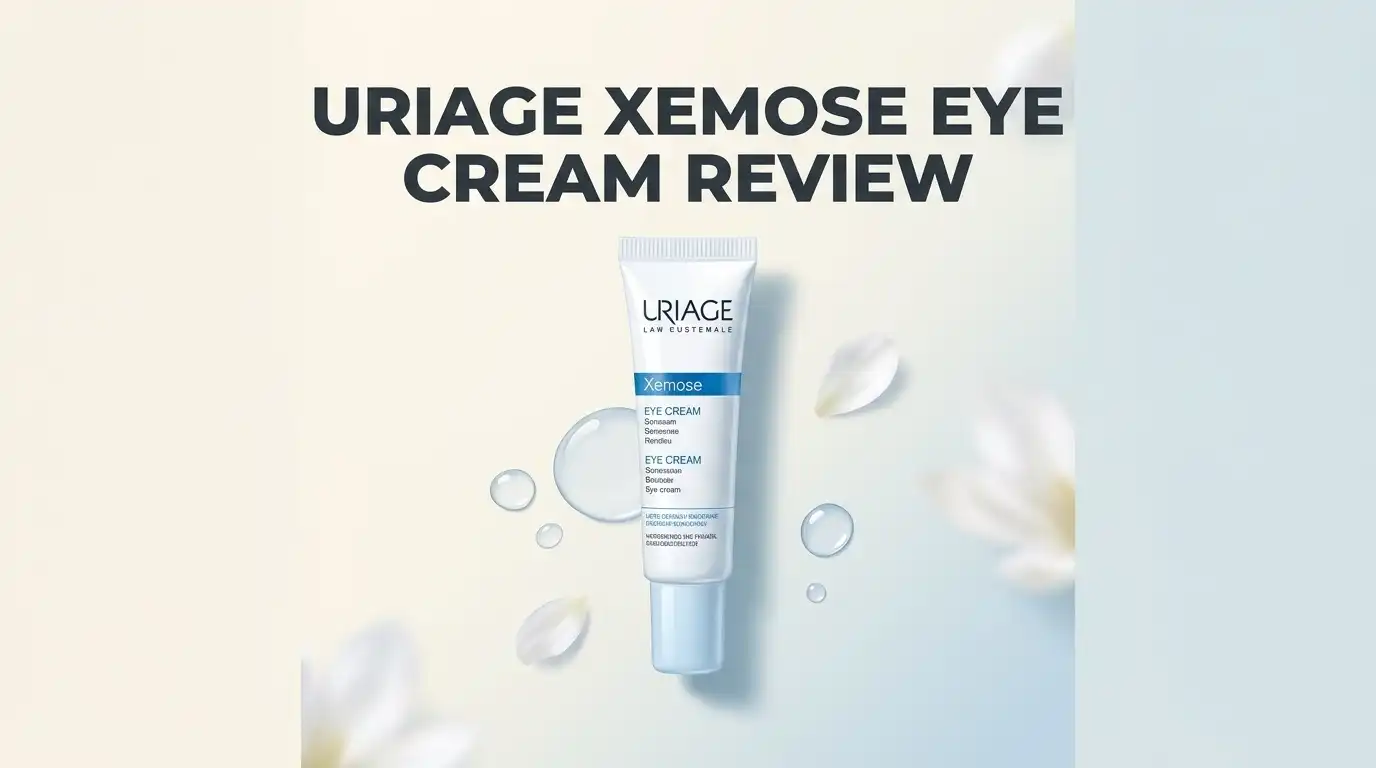
The box is small, matte white, with the Xémose blue banner. Nothing about it feels luxurious, and that is fine for a pharmacy product.
Inside sits a 15 ml aluminium-look tube, roughly four inches tall and slim enough to disappear into a coat pocket. A leaflet lists the full INCI and storage range.
My first observation was the tube opening. It is narrow, which forces a small dose and prevents the classic waste you get with wide-mouth eye creams.
The cap screws on properly and never popped open in a travel bag. Small thing, big relief for a product you carry through airports in dry cabin air.
The cream itself is opaque white and slightly glossy in the tube. It looks richer than most eye creams and thinner than the Xémose body balm.
No pump, no jar, no applicator wand. For sensitive, compromised skin, a sealed tube is the hygienic choice, and Uriage made the right call.
Texture, Scent And Absorption
The texture is a soft, dense cream. Think cold whipped butter that softens instantly against skin warmth rather than a slippery lotion.
It is completely unscented. Not “masked with a low-fragrance blend” but genuinely fragrance-free, which is the standard I want near my eyes.
A rice-grain amount covers both eyes. Push past that and you will feel it, because shea butter at 5% does not vanish.
Absorption takes about ninety seconds. The first thirty feel slightly slick, then the finish turns matte-soft with a faint cushioned feel.
There is no shine left behind, and no sting on application. I applied it directly to a cracked inner corner and felt nothing sharp.
Under makeup, results were mixed. Concealer sat fine after a two-minute wait, but applying immediately caused visible sliding at the outer corner.
At night it performs better. I woke with no transfer onto the pillow and no blurred vision on waking, which is a common complaint with heavier eyelid balms.
Top 3 Alternative For Uriage Xemose Eye Contour Care

- Toleriane Ultra Eye Cream helps to restore skin's natural moisture barrier around the eyes. Formulated with La Roche-Posay Thermal Spring Water and Neurosensine to provide instant & long-lasting comfort, soothe skin, and replenish skin's moisture barrier
- Neurosensine: A synthetic dipeptide, used to help skin feel soothed
Last update on 2026-08-06 / Affiliate links / Images from Amazon Product Advertising API Some of the links on this website are affiliate links, which means that at no additional cost to you, I earn a commission if you click through and make a purchase. I only recommend products and services that I believe will add value to my readers. Thank you for your support!
La Roche-Posay Toleriane Dermallergo Eye Cream

- [ UNDER EYE CREAM ] Puffy eye cream helps reduce puffiness in the under eye area. Depuffing eye cream with a non-greasy finish that leaves under eyes looking hydrated, smooth, brightened, and more awake.
- [ HYDRATING INGREDIENTS ] Moisturizing eye cream with Hyaluronic Acid to help retain skin's moisture and Niacinamide to help soothe skin. Multi-Vesicular Emulsion (MVE) ingredient-delivery technology continually releases ingredients to provide lasting hydration.
Last update on 2026-06-11 / Affiliate links / Images from Amazon Product Advertising API Some of the links on this website are affiliate links, which means that at no additional cost to you, I earn a commission if you click through and make a purchase. I only recommend products and services that I believe will add value to my readers. Thank you for your support!
CeraVe Eye Repair Cream

- Postbiotic innovation calms skin discomfort; Minimizes allergic reactions; Preservative-free & fragrance-free
- Apply to the face, neck & eye contour, morning & evening
Last update on 2026-08-06 / Affiliate links / Images from Amazon Product Advertising API Some of the links on this website are affiliate links, which means that at no additional cost to you, I earn a commission if you click through and make a purchase. I only recommend products and services that I believe will add value to my readers. Thank you for your support!
Avène Tolerance Control Soothing Recovery Cream
Inside The Formula
The opening is straightforward: water, dicaprylyl ether, shea butter, cetearyl isononanoate, glycerin. Emollients first, humectants close behind.
The interesting material sits deeper. You get Ceramide NP, NS, EOP and AP, plus cholesterol, behenic acid and glyceryl stearate.
That combination mirrors the natural lipid ratio of the stratum corneum. It is the difference between a cream that coats skin and one that helps rebuild it.
Sodium hyaluronate handles surface water binding. Sodium dextran sulfate is Uriage’s decongesting agent, historically used to reduce local puffiness.
Tocopherol and tocopheryl acetate provide antioxidant support. Lactic acid appears near the very end, almost certainly as a pH adjuster rather than an exfoliant.
Preservation comes from chlorphenesin and o-cymen-5-ol. Both are effective and both are recognised sensitizers for a small minority of users.
The emulsifiers steareth-2 and steareth-21 are worth flagging. They are common and generally well tolerated, but ethoxylated emulsifiers occasionally bother very reactive eyelid skin.
What The Clinical Claims Really Mean
Uriage publishes three headline numbers from its own study: 80% less itching, 81% less scaly skin, and 70% less dryness at day 30.
Read the fine print. The study covered 42 subjects, 30 adults and 12 children, which is a small sample by any standard.
The dryness figure came from dermatologist or paediatrician evaluation. The itching figure came from users and parents scoring themselves.
Self-reported itch data is soft. It is useful, but it is not blinded, placebo-controlled evidence.
The 48-hour anti-recurrence claim refers to the sensation of itching, not to eczema recurrence. Those are different things, and the asterisk says so.
None of this makes the cream ineffective. Barrier emollients have solid dermatological support, and this formula is built along established lines.
It simply means you should read those percentages as manufacturer-generated directional data, not as proof it will outperform the cheaper ceramide cream already in your cabinet.
Four Weeks On Dry, Itchy Eyelids
Week one delivered the clearest win. Morning tightness, the pulling sensation before you blink properly, dropped noticeably by day three.
Flaking took longer. Visible scale at my inner corners softened around day eight and had largely cleared by day twelve.
Itching was inconsistent. On low-humidity days I still scratched by mid-afternoon, though the urge felt duller than my usual baseline.
Redness was the slowest to move. Faint pink persisted through week three and only faded partially by week four.
The best result came from layering. Applying it over damp skin, straight after cleansing, extended comfort by several hours.
I also tested it as a spot treatment on a dry patch beside my nose. It worked there too, which tells you it is really a general emollient in eye-sized packaging.
Consumption was reasonable. After twenty-eight days of twice-daily use, I had used roughly a third of the tube, suggesting three months per unit.
Packaging That Works, With One Flaw
The tube design is genuinely good for reactive skin. Nothing touches the product except the nozzle, so contamination risk stays low.
Squeeze control is precise. Light pressure gives a small bead, and the tube walls hold their shape instead of collapsing unevenly.
The 15 ml size travels easily and fits liquid limits without a second thought.
Here is the flaw: there is no printed dosage guidance, and first-time users routinely dispense far too much.
Overapplication is the single biggest cause of the “it felt greasy” complaints I read. The formula is rich, and the packaging does nothing to signal restraint.
The white-on-white label is also hard to read in dim bathroom light. Trivial, but noticeable at 6 a.m.
One more practical note. Storage guidance is 6°C to 25°C, so a hot car glovebox will degrade the emulsion faster than you expect.
Who It Suits And Who Should Skip It
This cream fits very dry, flaking, atopy-prone eyelids almost perfectly. If your skin feels tight and papery around the orbital bone, it earns its place.
It also suits people who react to fragrance, essential oils, or drying alcohols. The formula omits all three.
Parents treating dryness on a child’s eyelids have a legitimate option here, since Uriage tested it on children as well as adults.
Now the honest exclusions. If you want retinol, caffeine, peptides or vitamin C results, this is the wrong purchase entirely.
Oily or congestion-prone skin around the eyes may struggle. Shea butter at this concentration can encourage milia in people already prone to them.
Anyone with a known sensitivity to chlorphenesin, o-cymen-5-ol or ethoxylated emulsifiers should patch test on the inner arm for three days first.
One recurring consumer report describes small red bumps appearing around day four. It is a minority experience, but eyelid skin is unforgiving, so take patch testing seriously.
Finally, if you have an active weeping flare, see a clinician. An emollient is support, not treatment.
Pros And Cons
Pros
- Genuine lipid architecture. Four ceramides plus cholesterol and behenic acid is a properly constructed barrier system, not marketing decoration.
- Fragrance-free, alcohol-free, ophthalmologist tested. It cleared the basic hurdles that disqualify most eye creams for eczema-prone skin.
- Fast comfort on tightness. Relief from that morning pulling sensation arrived within days rather than weeks.
- Hygienic, travel-friendly tube. Sealed packaging suits compromised skin far better than an open jar.
- Suitable for children and adults, which makes it practical for a shared household product.
Cons
- Expensive per millilitre. Around $51 per fluid ounce is a lot for a cream doing a fundamentally simple job.
- Redness response is slow. Flaking improved quickly; visible pink took weeks and never cleared completely for me.
- Too rich for some. Overapplication causes slip, and milia-prone users should proceed carefully.
- Small clinical sample. Forty-two subjects with partly self-reported outcomes is thin evidence.
- No dosage guidance on the tube, which practically guarantees waste in the first week.
- Poor makeup compatibility unless you wait a full two minutes before concealer.
How To Use It Properly
Use less than you think. A grain of rice covers both eyes, and anything more will slide.
Apply to slightly damp skin. Pat your face with a towel, leave it faintly moist, then press the cream in within a minute.
Tap it in with your ring finger. Do not drag or rub, since mechanical friction worsens eyelid dermatitis more than most people realise.
Cover the full area. That includes the mobile lid, the inner corner, and the outer edge where flaking usually starts.
Twice daily is the recommended rhythm. If you only manage once, choose night, when barrier repair activity peaks.
Wait two minutes before makeup. Rushing this step is why concealer creases and slides.
Give it four weeks before judging. Barrier lipids need repeated exposure, and a three-day trial tells you nothing except whether it stings.
If you also use a prescription eyelid treatment, apply the medication first, let it settle, then seal with this cream unless your clinician advises otherwise.
Final Verdict On Uriage Xemose Eye Contour Care
- Soothing action from the 1st application: Uriage Xemose C8+ Soothing Nourishing Palpebral Care – Very Dry Eyelids – Anti-scratching & irritation action, Soothes Immediately – Fragrance-Free - 8 Biomimetic Ceramides & 5% Shea Butter
- Target the 3 skin barriers: Acts on 3 skin barriers to help reduce the frequency of scratching due to dryness and improve quality of life for very dry skin.
Last update on 2026-08-06 / Affiliate links / Images from Amazon Product Advertising API Some of the links on this website are affiliate links, which means that at no additional cost to you, I earn a commission if you click through and make a purchase. I only recommend products and services that I believe will add value to my readers. Thank you for your support!
This is a competent, narrowly focused product that does the job it advertises and nothing beyond it.
The C8+ reformulation genuinely improved things. Eight biomimetic ceramides paired with cholesterol and 5% shea butter is a serious barrier formula by pharmacy standards.
For chronically dry, itchy, flaking eyelids, I would buy it again. The comfort it delivers in dry indoor air is real and arrives quickly.
For everyone else, the value case weakens fast. A general ceramide cream costs a third as much and works acceptably on most eye areas.
The Amazon rating of 4.4 stars across 276 reviews matches my experience: strong for the right skin, unremarkable for the wrong skin.
My score is 8 out of 10 for very dry, atopy-prone eyelids, and 5 out of 10 for anyone shopping for a general-purpose eye cream.
Buy it for the itch. Do not buy it for the wrinkles.
Expert FAQs
Can I use this on my actual eyelid, not just underneath?
Yes. Uriage tested it under ophthalmological control specifically on eyelid skin, and the product is sold as palpebral care.
Apply it gently to the mobile lid with your ring finger. Avoid the lash line itself to reduce the chance of product migrating into the eye.
Will it help with dark circles or puffiness?
Not meaningfully. Sodium dextran sulfate offers mild decongesting support, and hydrated skin always looks slightly brighter.
Structural dark circles caused by pigmentation, thin skin, or hollowing will not change. Choose a targeted formula for those concerns.
Is it safe for children?
Uriage includes children in its testing, and twelve of the 42 clinical subjects were children.
That said, paediatric eyelid dryness deserves a professional opinion first. Confirm with your child’s doctor before starting anything new near the eyes.
Can I wear it under makeup?
Yes, with a two-minute wait. Applied too quickly, it causes concealer to slide at the outer corner.
If you wear heavy eye makeup daily, consider reserving this for nights and using something lighter in the morning.
How long does one tube last?
Roughly three months at twice-daily use with a correct rice-grain dose.
Heavy-handed application cuts that closer to six weeks, which is where much of the “it is too expensive” frustration originates.
Does it sting or blur vision?
I experienced neither. The formula is fragrance-free and alcohol-free, which removes the two most common stinging culprits.
Blurring only occurs with excessive application near the lash line. Keep the dose small and it stays clear.
How does it compare to a basic ceramide eye cream?
The lipid profile is more complete, and the shea content makes it richer than most drugstore options.
For mild dryness, the cheaper option is genuinely sufficient. For persistent flaking and itch, the upgrade is defensible.
Can it replace my eczema medication?
No. It is a cosmetic emollient with no anti-inflammatory drug in the formula.
Use it as maintenance support alongside whatever your dermatologist prescribes, and discuss any changes to your routine with them first.

Hi, I’m Hazel Claire, the voice behind Modern Lens Blog, where I dive deep into the world of Amazon products across every niche imaginable. As a passionate product reviewer and everyday consumer, I test and evaluate everything from tech gadgets to home essentials, beauty products to fitness gear, bringing you honest, first-person insights that matter.